Replace teeth
Removable Partial & Full Dentures
See how removable replacement teeth work, how they are made, and how they compare with fixed options.
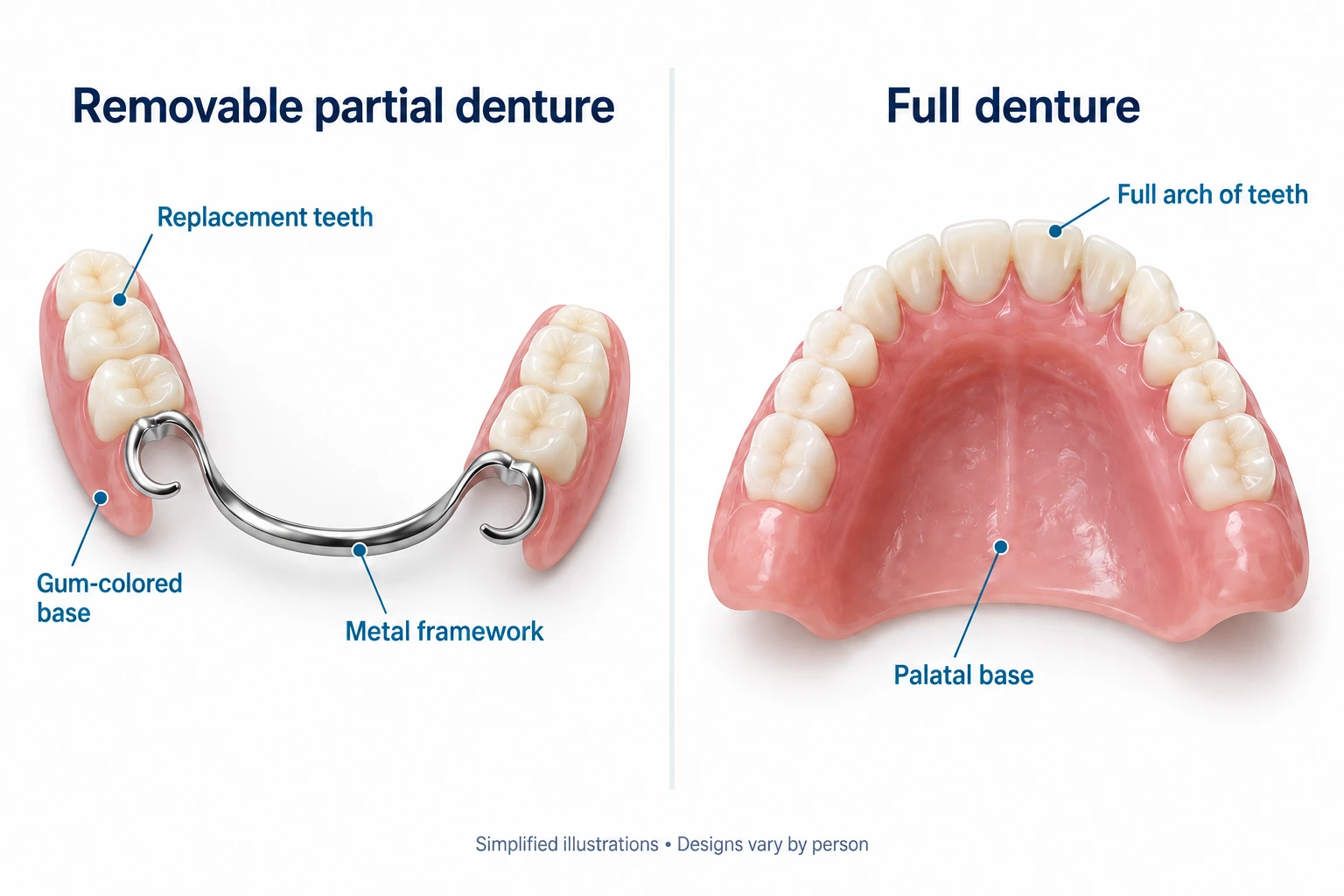
What it does
Removable prosthodontics means replacement teeth that you can take out yourself. A partial denture replaces some missing teeth; a full denture replaces all teeth in an upper or lower arch. The design depends on remaining teeth, gum and bone support, and the way your jaws meet.
Explore the source material ↗Watch the explanation
See the procedure in motion
Watch a removable denture snap into place
Loukas Dentistry · Dr. Thanasi Loukas
Connects to Loukas Dentistry · Dr. Thanasi Loukas when you choose to load.Watch a removable denture snap into place
A close-up clinical demonstration: the lower denture comes out, its underside and the implant attachments are shown, then it is reseated and the bite is checked.
Real patient footage, approximately 45 seconds, without audio. Watch the removal at 0:16 and reinsertion at 0:32. This is an implant-retained removable denture; conventional dentures have no implant attachments. The clip demonstrates attachment and bite checks, not chewing performance or guaranteed results.
If the player is unavailable, use the direct video link. Videos are external educational resources, not endorsements or personalized treatment advice. Publishers may include advertising; availability and captions vary. Loading connects to the video host and may share connection information or use cookies. Privacy notice.
What usually happens
The sequence and number of visits depend on the individual case.
Examination & design
The dentist assesses remaining teeth, gums and bite, then discusses suitable removable and fixed options.
Impressions & bite records
Impressions or suitable digital scans record the mouth. Bite records help position the replacement teeth in relation to the opposing arch.
Try-in & fabrication
Where appropriate, a trial setup lets the team check tooth position, appearance and bite before the appliance is finished.
Fitting & follow-up
The dentist checks pressure areas and bite and shows how to insert, remove and clean the denture. Follow-up adjustments help with comfort and function.
Benefits, limits & trade-offs
Removable dentures can be an alternative to fixed bridges or implant restorations, and conventional dentures are often less expensive initially than implants. They may move during eating or speaking, take time to get used to, and need adjustments, relining or replacement as the mouth changes. Compare comfort, support, appearance, cleaning and total maintenance costs—not price alone. Missing teeth should be assessed individually; dentures are not a reason to remove teeth that could be maintained.
Watch & explore further
Open the publisher’s page for videos, animations or more detailed reading.
External media opens only when you choose a link. Publishers may show advertisements or use cookies. Links do not imply endorsement or a partnership. Illustrations on Teeth.com are AI-generated, simplified explanations, not patient images.
Questions for your dentist
- Which remaining teeth can be maintained, and what would support a partial denture?
- What differences in chewing, appearance and cleaning should I expect with removable versus fixed options?
- Is this intended as a temporary or longer-term appliance?
- What adjustments, relines, repairs and follow-up are included?
Take the next step
Look for offices offering this care
Search for removable partial & full dentures in your area, then confirm the service with the office.
Opening Google Maps shares your search terms with Google. Results and rankings come from Google. Teeth.com has not verified these offices, their equipment, training or availability. A listing is not a recommendation.
Before you book
- Confirm that the office offers the specific procedure or technology you want to discuss.
- Ask who performs the treatment and about their relevant training and experience.
- Discuss whether it suits your situation, alternatives, the total fee and follow-up care.