Gums & surgery
Extractions & Wisdom Teeth
Do painless wisdom teeth need removal? Compare surgery, monitoring, recovery and risks with answers grounded in published evidence.
Watch: Do I Really Need My Wisdom Teeth Removed?
The decision explained
Do my wisdom teeth need removing if they do not hurt?
Pain alone does not decide. A wisdom tooth may have disease or threaten a neighboring tooth without hurting. Removal may be appropriate when disease or a significant risk is found; a disease-free tooth may be monitored. Ask what the examination and imaging show, and compare the risks of surgery with keeping the tooth. [2]
Read the answers and references ↓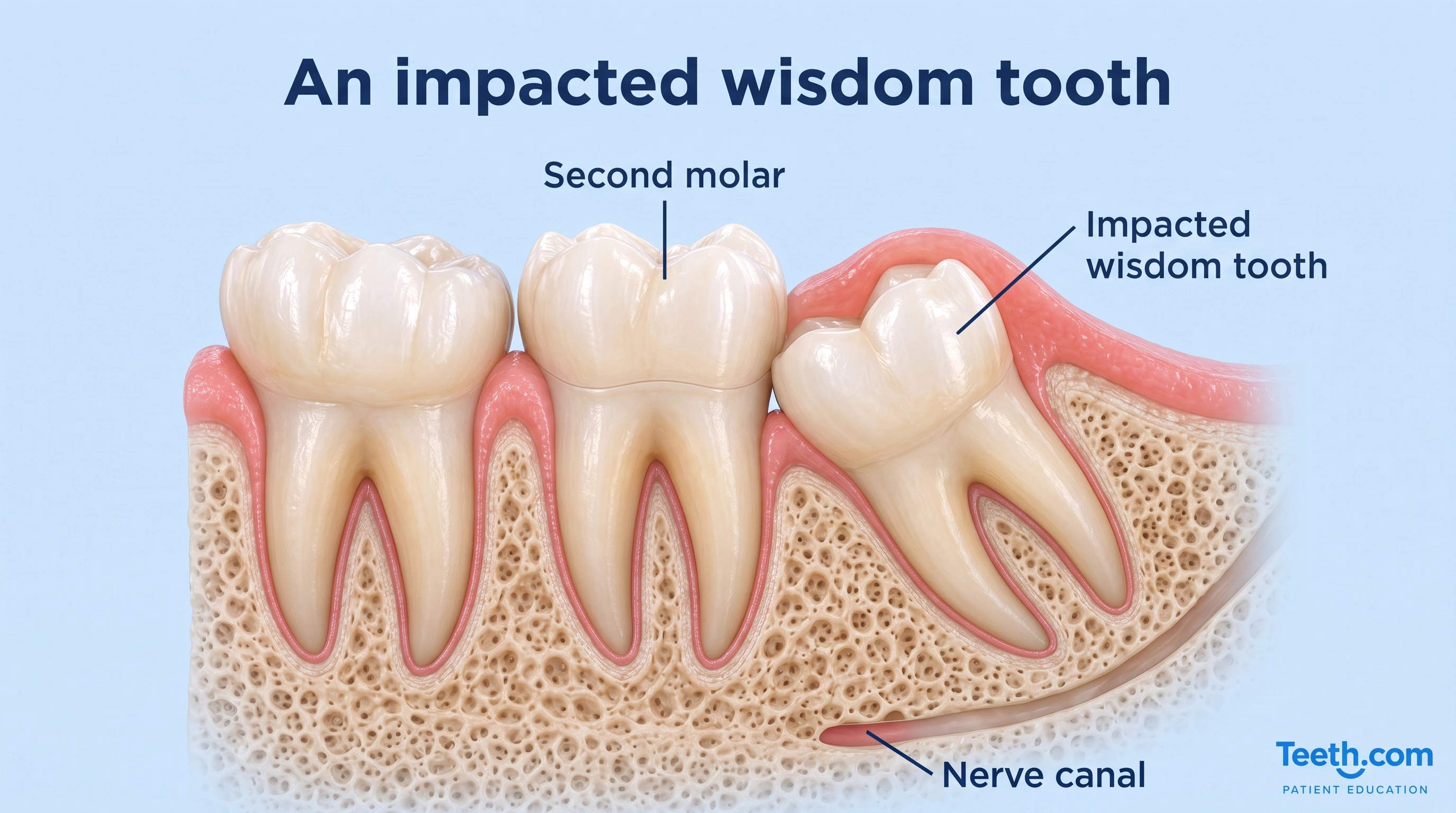
What it does
Extraction removes a tooth that cannot be kept or whose removal is indicated for another reason. Wisdom teeth need individual assessment; not every wisdom tooth must be removed.
Explore the source material ↗Watch the explanation
See the procedure in motion
Wisdom tooth removal explained
AAOMS
Connects to YouTube when you choose to load.Wisdom tooth removal explained
Learn about removing wisdom teeth from the American Association of Oral and Maxillofacial Surgeons.
Third-party educational demonstration by AAOMS. Inclusion is not an endorsement of a product, clinician, or treatment. Techniques and individual care vary.
This focuses on wisdom teeth. A straightforward extraction of another tooth may involve different steps.
If the player is unavailable, use the direct video link. Videos are external educational resources, not endorsements or personalized treatment advice. Publishers may include advertising; availability and captions vary. Loading connects to the video host and may share connection information or use cookies. Privacy notice.
Questions & evidence
More complete answers
These answers draw on the guidelines and literature linked below. Research can inform the options; an examination determines how they apply to your teeth.
What findings can make removal worthwhile?
The assessment considers decay, gum disease, infection, cysts, damage to adjacent teeth, position and whether the area can be kept healthy. An impacted tooth is one that cannot erupt normally; that label alone does not explain the treatment decision. Ask which finding or future risk justifies removal and whether observation is a reasonable alternative. [2]
What does research say about removing healthy, painless wisdom teeth?
Professional guidance and comparative research do not offer identical answers. The 2024 AAOMS statement favors early surgical management of impacted teeth, including those without enough room to erupt normally, while allowing monitoring in selected cases. It calls for weighing removal risks against retention risks and the availability of follow-up. This professional position should be read alongside the uncertainty in comparative trials described below. [1]
A 2020 Cochrane review found insufficient evidence to determine whether asymptomatic, disease-free impacted wisdom teeth should routinely be removed or retained. Only two eligible studies contributed evidence, with important limitations. A possible long-term risk to the neighboring second molar was very uncertain. This does not prove that keeping every tooth is safe or that preventive surgery benefits everyone. Your findings, surgical risks, preferences and ability to attend follow-up all matter. [3]
Will removing wisdom teeth prevent my front teeth from crowding?
That benefit has not been established. The Cochrane review found no clinically significant crowding benefit in the small trial that addressed it, and the evidence was low certainty. Ask for a tooth-specific reason for surgery rather than assuming removal will keep front teeth straight. [3]
What does monitoring involve if I keep them?
Monitoring means ongoing clinical assessment and imaging when indicated, not simply waiting for pain. The clinician checks the wisdom tooth and nearby tissues and teeth for change. Agree on follow-up and what would trigger treatment. Age, tooth position, overall health and surgical difficulty should be part of the discussion. [2]
What if a lower wisdom tooth is close to a nerve?
The surgeon assesses the roots and nearby nerve, sometimes with additional 3D imaging. For selected teeth, a coronectomy removes the crown but leaves roots to reduce the risk of injury to the nerve supplying the lower lip and chin. It is not suitable for every tooth, including some with unhealthy roots. Retained roots can move, become infected or need later removal. Discuss full removal, coronectomy and observation, including the possibility of persistent altered sensation. [4]
What happens during removal, and will I be asleep?
Local anesthetic numbs the area. Sedation or general anesthesia may be considered depending on difficulty, anxiety and the care setting. Surgery can involve opening the gum, dividing the tooth and placing stitches. Most patients go home the same day. Follow the team’s instructions about preparation, an escort and driving after sedation or anesthesia. [5]
How long does recovery take, and how do I protect the socket?
Recovery varies with the operation. Swelling and soreness can increase during the first few days before settling; some discomfort may last a couple of weeks. Follow your surgeon’s plan and contact the team if recovery is not progressing as expected. [6]
Aftercare commonly includes precautions to protect the blood clot. The treating team’s written instructions explain cleaning, food, bleeding control and medicines for the particular procedure. Instructions can vary with the operation and the patient’s health; general information does not replace that plan. [6]
Do I need opioids or antibiotics afterward?
The ADA’s 2024 guideline recommends nonopioid medicines as first-line treatment for extraction pain in adolescents and adults. An anti-inflammatory such as ibuprofen, alone or with acetaminophen, may be suitable, but your health and other medicines can change the choice. Follow an individualized plan and avoid duplicate ingredients. Opioids are reserved for selected circumstances, with the lowest effective dose and shortest duration. [7]
Preventive antibiotics are a separate decision. A 2021 Cochrane review found low-certainty evidence of fewer infections and dry sockets, largely in healthy people having impacted wisdom teeth surgically removed. The results cannot be assumed to apply to all extractions or medically complex patients. Potential benefit must be weighed against adverse effects and antibiotic resistance. Ask why an antibiotic is indicated for you; do not self-start leftover medication. [8]
What is dry socket, and what other problems can occur?
Dry socket is a painful healing problem when the protective clot fails to form properly or is lost. Infection and nerve-related numbness or tingling are other possible complications. Contact the treating team about severe or worsening pain, swelling, fever, a bad taste with pain, or bleeding that does not stop. [5]
Heavy mouth bleeding that will not stop, or severe swelling affecting breathing, needs emergency care. Do not wait for a routine follow-up appointment. [9]
References and evidence notes (9)
Clinical guidelines and scientific reviews inform the options. Patient guidance provides practical explanations and aftercare information. International guidance is identified by its publisher and may differ from U.S. practice; its service numbers and payment rules do not apply in the United States. A citation is not an endorsement of Teeth.com or a personal treatment recommendation.
- The Management of Impacted Third Molar TeethAmerican Association of Oral and Maxillofacial Surgeons. Clinical condition statement, 2024.Professional position statement · Full text checked November 6, 2026. Favors surgical management, with monitoring in selected cases; not a randomized comparison of routine removal versus retention.
- Management of Third Molar TeethAmerican Association of Oral and Maxillofacial Surgeons. White paper, 2016.Professional position statement · Recommends surgery for disease or significant risk and active surveillance otherwise; this is professional guidance, not a randomized trial.
- Surgical removal versus retention for the management of asymptomatic disease-free impacted wisdom teethGhaeminia H, Nienhuijs MEL, Toedtling V, et al. Cochrane Database of Systematic Reviews. 2020;5:CD003879. DOI: 10.1002/14651858.CD003879.pub5.Systematic review · Published abstract and plain-language summary checked. Search through May 2019; evidence was low or very low certainty.
- CoronectomyBritish Association of Oral and Maxillofacial Surgeons. Publication date not stated.Specialist patient guidance
- Wisdom tooth removalNHS. Reviewed June 12, 2024.Patient guidance
- Dental extractions: post-operative instructionsUniversity College London Hospitals NHS Foundation Trust. Publication date not stated.Hospital aftercare guidance
- Acute Dental Pain Management GuidelineAmerican Dental Association. Adult and adolescent guideline and postoperative chairside guide, 2024.Evidence-based clinical guideline · Post-extraction recommendations and safety statements checked; the cited medication recommendations are conditional with low-certainty evidence.
- Antibiotics to prevent complications following tooth extractionsLodi G, Azzi L, Varoni EM, et al. Cochrane Database of Systematic Reviews. 2021;2:CD003811. DOI: 10.1002/14651858.CD003811.pub3.Systematic review · Published abstract and plain-language summary checked. Evidence through April 2020; mainly healthy wisdom-tooth surgery patients.
- How to find an NHS dentist in an emergencyNHS. Reviewed May 14, 2025.Urgent-care patient guidance · Used for warning signs; UK service numbers and payment arrangements do not apply here.
Literature and guidance checked October 26, 2026 with AI assistance. General education, not a personal treatment recommendation. Our editorial approach.
What usually happens
The sequence and number of visits depend on the individual case.
Evaluate
An examination and appropriate imaging guide the decision.
Plan comfort
Discuss local anesthesia and any additional sedation needs.
Remove
The clinician removes the tooth; some cases require a surgical approach.
Protect healing
Follow the aftercare plan and discuss replacement when appropriate.
Benefits, limits & trade-offs
Bleeding, infection, dry socket and nerve injury are possible. Ask whom to contact for problems. Difficulty breathing or swallowing requires emergency help.
Watch & explore further
Open the publisher’s page for videos, animations or more detailed reading.
External media opens only when you choose a link. Publishers may show advertisements or use cookies. Links do not imply endorsement or a partnership. Illustrations on Teeth.com are AI-generated, simplified explanations, not patient images.
Questions for your dentist
- Why remove this tooth now?
- Who provides after-hours advice?
- Will this space need a replacement or graft?
Take the next step
Look for offices offering this care
Search for extractions & wisdom teeth in your area, then confirm the service with the office.
Opening Google Maps shares your search terms with Google. Results and rankings come from Google. Teeth.com has not verified these offices, their equipment, training or availability. A listing is not a recommendation.
Before you book
- Confirm that the office offers the specific procedure or technology you want to discuss.
- Ask who performs the treatment and about their relevant training and experience.
- Discuss whether it suits your situation, alternatives, the total fee and follow-up care.