Repair & preserve
Fillings & Tooth Repair
When a cavity needs a filling, when early decay can be stopped, and how repair and material choices compare—with references.
Watch: Do I Really Need a Filling?
The decision explained
Do I really need a filling, or can this cavity be stopped?
Early decay before a hole forms can sometimes be stopped or reversed. A filling repairs lost tooth structure; it does not replace prevention. Ask whether the surface is intact, how deep the decay is and whether monitoring with a specific treatment plan is appropriate. [2][3]
Read the answers and references ↓A rough edge or missing piece?
A tooth or filling broke. What now?
A short guide to contacting your dentist and explaining what happened.
42 sec · Patient educationAI-assisted presenter and illustrations · Captions included in the picture · General education.
General dental education only—not a diagnosis or personal treatment recommendation. AI-generated presenters are illustrative characters, not clinicians providing care. This video does not replace an examination or create a dentist–patient relationship. Do not delay professional care because of a video. Educational limitations.
The illustration shows one example: a broken cusp beside an alloy filling that remains in place.
Read the video transcript
You notice a rough edge—part of your tooth or filling may have broken. What now?
Contact your dentist, even if it doesn’t hurt. They’ll check the tooth and explain whether it needs another filling or a different repair.
Temporary precautions commonly include gentle cleaning and protecting the damaged tooth from heavy biting. A dental office can explain suitable care until assessment.
When you call, mention when it happened, any sharp edges, and whether you have pain, sensitivity or swelling.
Severe pain or swelling needs urgent dental advice. Trouble breathing or swallowing needs emergency care.
Sources: NHS Wales: lost filling or crown · NHS: urgent dental care · NHS: emergency signs.
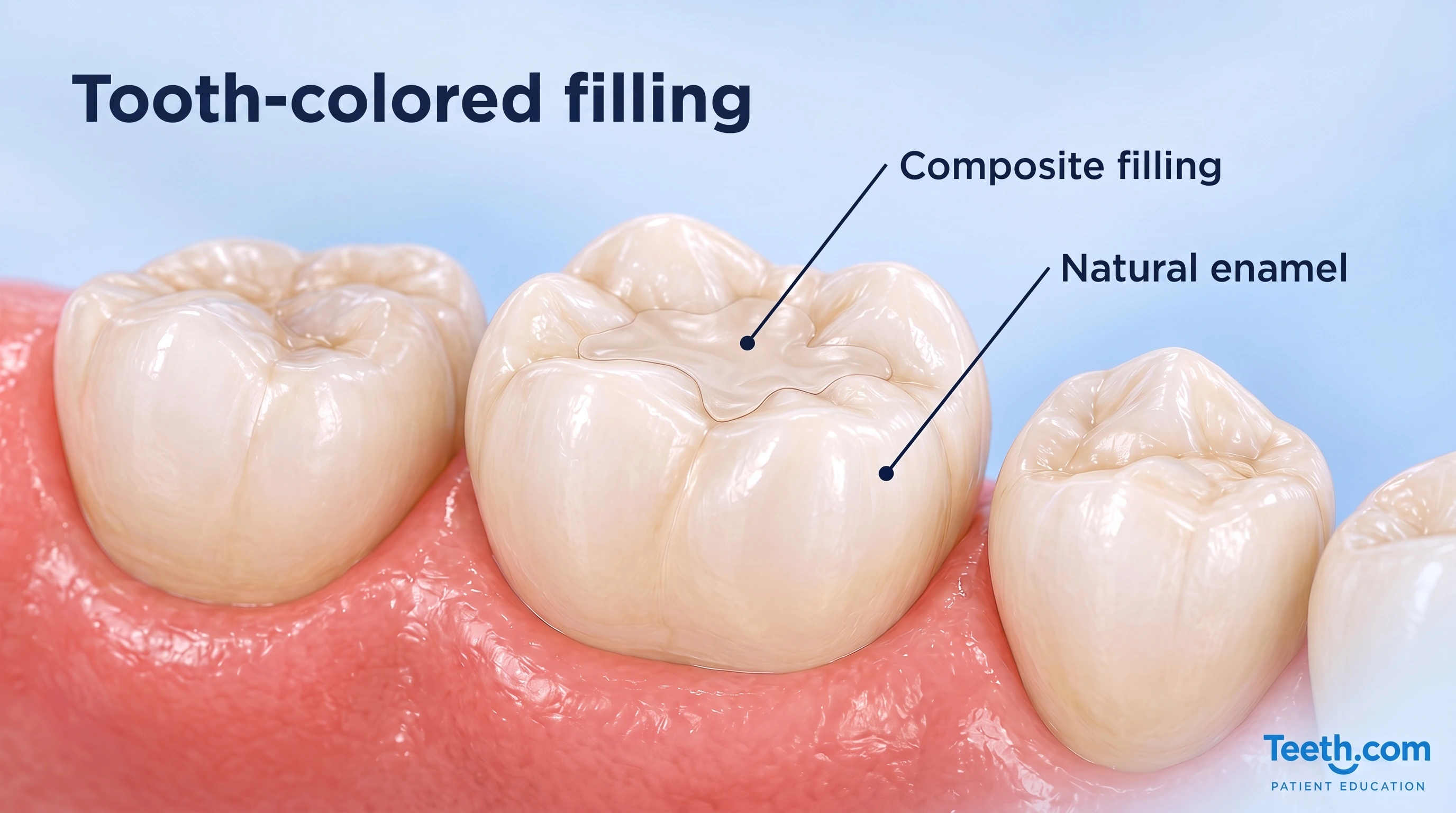
What it does
A filling restores an area damaged by decay. Material choice depends on the location and size of the cavity, your health, preferences and the dentist’s assessment.
Explore the source material ↗Take a closer look
See the layers of a tooth on a real X-ray
Use this example to recognize the main layers. It is not an example of a cavity or a test for whether you need a filling.
Enamel on a dental X-ray
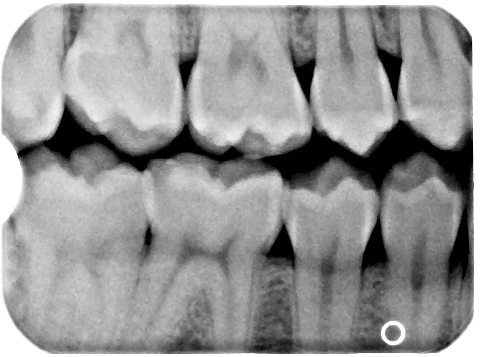
What to look forThe bright outer layer over each chewing surface is enamel. The grayer layer inside is dentin, surrounding the darker pulp space.
A bitewing shows portions of the upper and lower back teeth. Cells and microscopic details are too small to see on this image.
Source & image credit
Dr Jeffrey Cross DDS, via Wikimedia Commons (2014). View source ↗ · CC BY-SA 3.0.
Original radiograph unchanged; displayed at reduced size. No teaching markers have been added to this view.
Open original image ↗Watch the explanation
See the procedure in motion
What happens during a filling?
Colgate Professional
Connects to YouTube when you choose to load.What happens during a filling?
A visual walkthrough of treating a cavity and restoring the tooth with a filling.
Third-party educational demonstration by Colgate Professional. Inclusion is not an endorsement of a product, clinician, or treatment. Techniques and individual care vary.
Commercial publisher’s educational demonstration.
If the player is unavailable, use the direct video link. Videos are external educational resources, not endorsements or personalized treatment advice. Publishers may include advertising; availability and captions vary. Loading connects to the video host and may share connection information or use cookies. Privacy notice.
Questions & evidence
More complete answers
These answers draw on the guidelines and literature linked below. Research can inform the options; an examination determines how they apply to your teeth.
Can a cavity heal without a filling?
The distinction is between early mineral loss and a physical hole. Saliva and fluoride can help repair early enamel damage before the surface breaks down. They cannot rebuild a missing piece of tooth. A hole often needs a restoration to restore shape and function. [2]
Why treat decay if my tooth does not hurt?
Early decay often has no symptoms. The dentist assesses the tooth and uses X-rays when needed to understand its extent. Ask to see the findings and discuss the consequences of treating or waiting; lack of pain does not establish that decay is harmless. [2]
What treatments can stop decay without drilling?
Options depend on the surface and stage of the lesion. ADA guidance includes fluoride treatments, sealants and resin infiltration for selected lesions without a hole. Silver diamine fluoride can help arrest selected cavitated lesions, but darkens treated decay and does not rebuild tooth shape. These are professional treatment choices with follow-up, not interchangeable home remedies. Ask about appearance, cleaning, repeat applications and how the dentist will confirm that the lesion has stopped progressing. [3]
Does the dentist have to remove every bit of softened dentin?
Not always. The ADA’s 2023 guideline favors selective removal for moderate or advanced decay in suitable vital permanent teeth requiring a restoration. This may leave some softened dentin near the pulp while the tooth is restored, to reduce the risk of exposing the pulp. It is a deliberate treatment technique, not an instruction to leave a cavity open. The recommendation is conditional and the evidence certainty is very low. Teeth with pulp disease need a separate assessment; this approach does not guarantee avoiding root canal treatment. [4]
The 2025 AAPD permanent-tooth guideline strongly supports selective removal for deep decay when the pulp is normal or reversibly inflamed. Extremely deep lesions or spontaneous, nighttime or lingering pain require a different assessment; the guideline may favor complete removal to evaluate the pulp. The amount removed depends on the diagnosis, not simply the color of the dentin. [1]
Which filling material is best?
No material is best for every cavity. Tooth position, surfaces involved, moisture control, health and preferences affect the choice. Many material comparisons in the ADA guideline have low or very low certainty. Ask why the proposed material suits your tooth. [4]
Should I replace an old silver filling because it contains mercury?
The FDA does not recommend removing an intact amalgam filling without decay solely to prevent disease, unless removal is medically necessary. Removal sacrifices tooth structure and temporarily increases mercury-vapor exposure. For new fillings, the FDA encourages suitable alternatives in certain groups, including people who are pregnant, planning pregnancy or breastfeeding; children, especially under six; and people with impaired kidney function, certain neurological conditions or sensitivity to amalgam components. Discuss your circumstances with your dentist. [5]
Can a damaged filling be repaired instead of replaced?
Sometimes. A localized defect may allow a repair, and some roughness or surface staining may only need refinishing. The dentist should first identify the cause of the problem and assess decay risk, remaining tooth and the restoration as a whole. FDI guidance recommends considering repair case by case because complete replacement removes additional tooth tissue. It does not mean every defective filling can safely be patched. [6]
What happens during a filling, and what if it hurts afterward?
Local anesthetic can numb the area. The dentist prepares the tooth, places and shapes the material, then checks the bite. Tell the dentist if you feel pain during treatment. Follow instructions about eating and be careful not to bite your cheek or tongue while numb. [7]
Temporary mild sensitivity or gum soreness can occur. A filling that feels high or hurts when you bite needs a bite check. Contact the dentist about persistent or worsening pain, a broken filling, or lingering pain after hot or cold. Facial swelling, fever or severe pain needs prompt assessment. These symptoms do not identify the cause on their own. [7]
How long will a filling last, and how can I avoid another cavity?
A filling has no guaranteed replacement date. Its material and condition matter; the dentist checks whether it is still functioning or needs attention. Discuss repair before assuming that an older filling must be replaced. [7][6]
Keep brushing twice daily with fluoride toothpaste and cleaning between teeth. Limit frequent sugary drinks and snacks, and attend follow-up visits. Repairing a cavity does not remove the conditions that caused the decay. [2]
References and evidence notes (7)
Clinical guidelines and scientific reviews inform the options. Patient guidance provides practical explanations and aftercare information. International guidance is identified by its publisher and may differ from U.S. practice; its service numbers and payment rules do not apply in the United States. A citation is not an endorsement of Teeth.com or a personal treatment recommendation.
- Guideline for Use of Vital Pulp Therapy in Permanent TeethColl JA, Dhar V, Guelmann M, et al. Pediatric Dentistry. 2025;47(5):299–311.Evidence-based clinical guideline · U.S. AAPD guideline; recommendations include mature permanent teeth in adults and immature permanent teeth. Evidence certainty and recommendations depend on the diagnosis and procedure. Targeted update checked November 6, 2026.
- Tooth DecayNational Institute of Dental and Craniofacial Research. Reviewed September 2025.Patient guidance
- Nonrestorative Treatments for Carious Lesions Clinical Practice GuidelineAmerican Dental Association. 2018.Evidence-based clinical guideline · Guideline summary and permanent-teeth chairside recommendations checked. Treatment and evidence strength differ by lesion type; journal full text was not accessible.
- Restorative Treatments for Caries Lesions Clinical Practice GuidelineAmerican Dental Association. 2023; permanent-teeth chairside guide adapted 2024.Evidence-based clinical guideline · Summary and chairside guide checked. Recommendations cited here concern vital permanent teeth needing a restoration, without pulp therapy.
- Dental Amalgam FillingsU.S. Food and Drug Administration. Publication date not stated on the accessed page.Regulatory patient guidance
- Repair of RestorationsFDI World Dental Federation. Adopted September 2019.Professional policy statement · Supports individualized repair decisions; long-term comparative evidence remains limited.
- Dental FillingsCleveland Clinic. Updated May 13, 2024.Patient guidance · Used for procedure and aftercare information; the ADA guideline informs the selective-removal answer.
Literature and guidance checked October 26, 2026 with AI assistance. General education, not a personal treatment recommendation. Our editorial approach.
What usually happens
The sequence and number of visits depend on the individual case.
Assess the tooth
The dentist checks the extent of decay and explains whether a filling can restore it.
Prepare the area
The affected area is prepared for the chosen material.
Place the restoration
The filling is placed and shaped according to the material’s requirements.
Check function
The dentist checks the bite and explains follow-up care.
Benefits, limits & trade-offs
An intact amalgam filling generally should not be removed solely to prevent disease. Discuss symptoms or material concerns with your dentist.
Watch & explore further
Open the publisher’s page for videos, animations or more detailed reading.
External media opens only when you choose a link. Publishers may show advertisements or use cookies. Links do not imply endorsement or a partnership. Illustrations on Teeth.com are AI-generated, simplified explanations, not patient images.
Questions for your dentist
- How much healthy tooth remains?
- Why is this material suitable here?
- Can the existing restoration be repaired rather than replaced?
Take the next step
Look for offices offering this care
Search for fillings & tooth repair in your area, then confirm the service with the office.
Opening Google Maps shares your search terms with Google. Results and rankings come from Google. Teeth.com has not verified these offices, their equipment, training or availability. A listing is not a recommendation.
Before you book
- Confirm that the office offers the specific procedure or technology you want to discuss.
- Ask who performs the treatment and about their relevant training and experience.
- Discuss whether it suits your situation, alternatives, the total fee and follow-up care.